
Is MSTR a Ponzi Scheme? The Truth About Michael Saylor’s Bitcoin Strategy
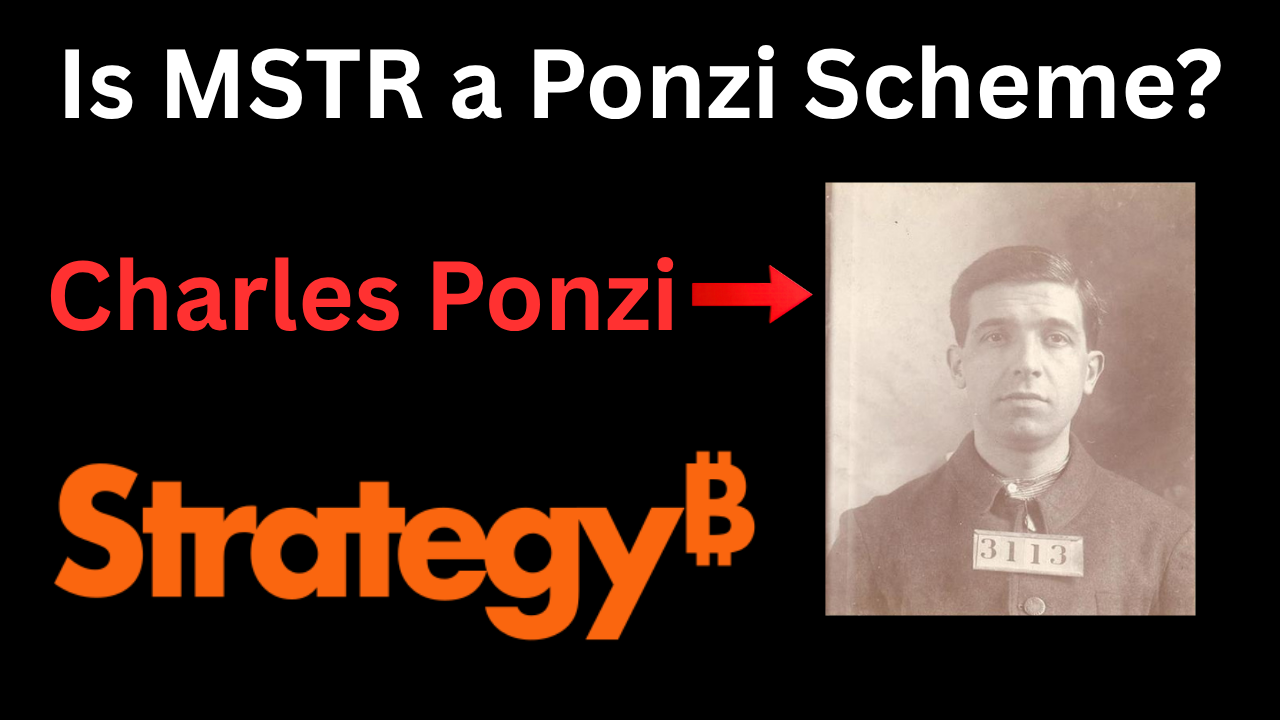
Is MSTR a Ponzi scheme… or one of the most misunderstood investment strategies in the market today?
With Michael Saylor aggressively buying Bitcoin using debt, stock dilution, and preferred shares, MSTR stock critics are getting louder.
I ran a poll on the MSTR Investor Youtube channel to find out if investors think MSTR is just a ponzi scheme waiting to collapse. 20% of respondents believed that MSTR was a ponzi scheme to my surprise!

In this post, we’ll break down:
- What a Ponzi scheme really is
- How Strategy (MSTR) actually works
- The biggest risks investors are ignoring
What Is a Ponzi Scheme?
A Ponzi scheme is a type of fraud where returns are paid to earlier investors using money from new investors—rather than from actual profits.
It was named after Charles Ponzi (1882–1949) was an Italian-born con artist who became infamous for creating the first widely known Ponzi scheme in the United States.

He immigrated to the U.S. in the early 1900s and, in 1920, launched an investment operation in Boston that promised investors 50% returns in 45 days (or 100% in 90 days).
How His Scheme Worked
Ponzi claimed he was profiting from arbitraging international postal reply coupons—a real concept, but massively exaggerated.
In reality, he wasn’t generating legitimate profits.
Instead, he used money from new investors to pay earlier investors, creating the structure now known as a Ponzi scheme.
At Its Peak
- Thousands of investors poured money in
- Millions of dollars were raised (equivalent to tens of millions today)
- The operation relied entirely on new inflows of cash
The Collapse
The scheme unraveled when:
- Too many investors tried to withdraw funds
- New investor money slowed down
Ponzi was arrested, convicted of fraud, and eventually deported.
Why His Name Still Matters
The term “Ponzi scheme” comes directly from Charles Ponzi and is now used to describe any fraudulent investment that:
- Pays old investors with new investor money
- Lacks a real underlying business or asset
- Requires constant inflows to survive
- Eventually collapses
Key characteristics:
- No real underlying asset
- Promises of consistent or guaranteed returns
- Requires constant inflow of new money
- Eventually collapses when inflows stop
If MSTR fits this definition, that would be a serious problem.
What Does Strategy (MSTR) Actually Do?
Strategy (formerly MicroStrategy) started as a software company—but today, it’s best known for its Bitcoin treasury strategy.
Here’s how it works:
- Raise capital (stock, debt, preferred shares)
- Use that capital to buy Bitcoin
- Increase Bitcoin per share over time
Instead of holding cash, the company treats Bitcoin as its primary reserve asset.
At the center of this strategy is Michael Saylor, who believes Bitcoin is the best long-term store of value.
Why Some People Think MSTR Is a Ponzi Scheme
Let’s be fair—there are reasons people raise this concern.
1. Share Dilution
Strategy frequently issues new shares through ATM offerings.
Critics argue:
New investors are funding Bitcoin purchases that benefit existing shareholders.
2. Debt and Leverage
The company has issued billions in convertible notes.
Risk:
- If Bitcoin drops significantly, leverage can amplify losses
3. Preferred Shares (STRK, STRF, STRC, etc.)
These offer high yields (often around ~10%+).
Critics say:
This looks like income being paid using new capital rather than business profits.
4. mNAV Premium
MSTR often trades above the value of its Bitcoin holdings.
Skeptics argue:
- This premium depends on investor demand
- If sentiment shifts, the premium could collapse
Why MSTR Is NOT a Ponzi Scheme
Despite the concerns, MSTR does not meet the definition of a Ponzi scheme.
1. It Owns Real Assets (Bitcoin)
Unlike a Ponzi scheme, Strategy holds billions in Bitcoin.
That’s a transparent, verifiable asset.
2. No Guaranteed Returns
Ponzi schemes promise fixed or consistent returns.
MSTR does not promise anything:
- The stock goes up and down with Bitcoin
- Investors take full market risk
3. Public Company Transparency
Strategy is a publicly traded company with:
- SEC filings
- Audited financials
- Full disclosure of capital raises
That’s the opposite of a hidden fraud.
4. It’s a Capital Markets Strategy
What Strategy is doing is aggressive—but not unique.
It’s similar to:
- Leveraged ETFs
- REIT-style capital structures
- Closed-end funds trading at premiums
The company is simply using capital markets to accumulate an asset it believes will appreciate.
Understanding the REAL Risk
This is where most people get it wrong.
MSTR is not a Ponzi scheme… but it is high risk.
The real risks:
- Bitcoin volatility
- Share dilution over time
- Debt obligations
- mNAV premium compression
If Bitcoin performs well → MSTR can outperform massively
If Bitcoin struggles → MSTR can underperform quickly
The Bull Case for MSTR
Why are investors still buying?
- Leveraged exposure to Bitcoin
- Bitcoin per share continues to grow
- Potential upside during bull markets
- Short squeeze potential
For bullish Bitcoin investors, MSTR is a high-beta play.
The Bear Case (Legit Concerns)
Even if it’s not a Ponzi, critics raise valid points:
- Overdependence on Bitcoin price
- Premium valuation may not be sustainable
- Constant capital raises may slow
- Sentiment drives valuation more than fundamentals